01
Resident Asks
A plain-language question starts the process.
›
The Curia.IQ local government knowledge assistant helps PIOs and departments reduce routine phone and email volume without asking residents to learn the structure of city government.
Ask “When is trash pickup?”, “Where do I vote?”, “Will there be trash on New Year’s Eve?” or “How do I apply for a permit?” Answers are constructed from approved source material and include direct citations when available.
Residents can ask questions in 95 languages and receive translated responses while the source knowledge remains anchored to the municipality’s official content.
Review question volume, top topics, source usage, answer coverage, and unanswered-question logs to identify where web content needs improvement.
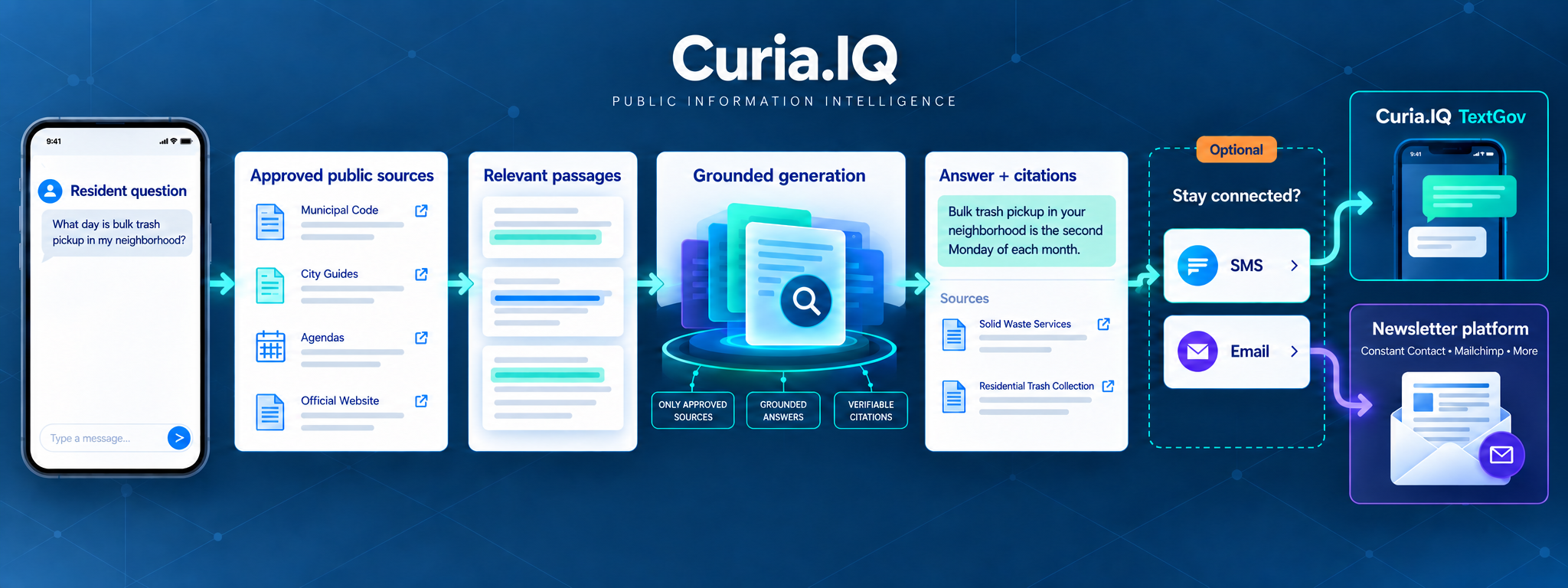
Curia.IQ retrieves relevant passages from approved city information before generating a response—so every useful answer begins with evidence. This evidence-first approach uses retrieval-augmented generation (RAG) to ground AI-generated answers in relevant source material before a response is created.
A plain-language question starts the process.
›City pages and documents define the knowledge boundary.
›The system searches for meaning, not only matching words.
›The strongest supporting excerpts move forward.
›The model answers within the retrieved evidence.
›Residents receive a clear response with source links.
If you choose to enable engagement integrations, Curia.IQ can invite residents to receive future updates after their question is answered. Nothing is added without the resident's affirmative consent.
The agent asks whether the resident wants text messages, email newsletters, or both, and collects only the information needed for the option selected.
With consent, the resident's mobile information is sent to the optional Curia.IQ TextGov module for future SMS announcements and engagement.
With consent, the resident's email information is automatically sent to your selected newsletter platform, such as Constant Contact, Mailchimp, or another compatible provider.
See exactly which questions repeatedly fail because your city or county hasn’t published an answer anywhere in its official sources. Instead of guessing what residents don’t understand about your services, you get a ranked list of real, recurring information gaps — the questions people are actually asking that your current website, FAQs, or public records simply don’t address yet. This turns every unanswered query into a concrete to-do item for your communications or web team.
With an AI chat agent for local government, you can spot spikes in resident interest before they show up as a flood of phone calls or counter visits. Track increases in questions around elections, sanitation schedules, permitting, tax deadlines, road projects, or council actions — often in the hours or days after a policy change, a public notice, or a weather event, well before your staff would otherwise notice the pattern. This gives you a leading indicator of what residents are worried about right now, so you can get ahead of it with a proactive notice or an FAQ update instead of reacting one call at a time.
Quantify how many resident questions are actually attempts to do something transactional — report a pothole, request a service, look up a permit status, pay a bill — rather than simply find information. This gives you real usage data to justify (or de-prioritize) investment in deeper system integrations, whether that’s a 311/CRM platform, a permitting system, utility billing, GIS-based service requests, or another back-end system your government already runs. Instead of integrating on a hunch, you can point to actual demand: how often it comes up, what residents are trying to accomplish, and which system would resolve the most real requests.